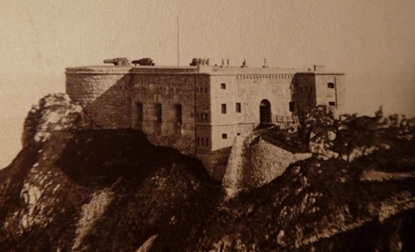
The Fortification of St. Catherine’s Island
The fortification of St. Catherine’s Island represents a pinnacle of Victorian coastal engineering, born from the 1860 Royal Commission on the Defence of the United Kingdom. Constructed between 1867 and 1870, the fort was designed as a “Palmerston Folly”—a strategic sea battery intended to protect the Royal Dockyards at Pembroke Dock and the approaches to the Bristol Channel from potential French naval incursions.
The structure itself is a marvel of granite and limestone, built to withstand the punishing Atlantic swells and the impact of modern heavy artillery. During its active service, the fort was manned by a dedicated garrison, typically consisting of 1 officer and 48 men. These soldiers lived in isolation on the rock, tasked with the operation of the island’s tiered defensive capabilities.
While the roof stood ready with the formidable 9-inch Rifled Muzzle Loading (RML) guns, the heart of the fort’s firepower was also distributed within the casemates. These internal chambers housed 7-inch RML guns, providing a multi-layered defense that could sweep the surrounding waters from protected positions.
Despite its imposing presence and state-of-the-art weaponry, the fort never fired a shot in anger. By the dawn of the 20th century, rapid advancements in naval technology rendered the static coastal battery obsolete. In 1907, the War Office decommissioned the site, leading to its eventual sale to Evan Jones for the sum of £500.00. This transition marked the end of the island’s martial history and the beginning of its life as a private domestic residence.
Technical Bulletin: Garrison & Armament
| Category | Specification |
| Construction Era | 1867 – 1870 |
| Primary Purpose | Coastal Sea Battery |
| Standard Garrison | 1 Officer, 48 Men |
| Primary Armament (Roof) | 9-inch RML Guns |
| Secondary Armament (Casemates) | 7-inch RML Guns |
| Decommissioned | 1907 |